High-frequency vs. pneumatic grinders for cast-iron grinding: what should a foundry measure?
For European foundries and other plants equipped with compatible 300Hz power, grinder selection affects material removal, abrasive use and maintenance. This article examines FUJI’s reported HGC-3902 field comparison with pneumatic and standard AC angle grinders, then explains the model’s operating limits and practical service requirements.
The purpose is to help buyers plan a meaningful production trial. Results from the tested equipment are not a guarantee that every high-frequency grinder will outperform every air or AC tool by the same margin.
The FUJI HGC-3902 high-frequency angle grinder for foundry castings uses a brushless three-phase motor and a compatible 300Hz supply. It is intended for demanding industrial grinding, including cast-iron stock removal and weld grinding with an appropriately selected wheel.
FUJI’s KOSOKU range includes high-frequency equipment for different power systems. Frequency is a compatibility requirement, not a standalone measure of grinding performance: motor design, gearing, rated output, wheel diameter and operating speed must be considered together. Do not treat 250Hz and 300Hz equipment as interchangeable without model-specific approval.

FUJI’s original report describes a four-hour comparison on cast-iron workpieces. The recorded material-removal totals are retained below. They are cumulative removed mass, not material removal rates expressed per minute.
| Recorded measure | FUJI HGC-3902, 300Hz | Pneumatic sample | Standard AC sample |
|---|---|---|---|
| Total material removed in the reported four-hour test | 2002g | Approximately 550g | 700g |
| FUJI removed-mass ratio relative to this sample | Reference | Approximately 3.64× | Approximately 2.86× |
Interpretation: The HGC-3902 removed more material in the reported comparison. The figures do not establish that one operator can replace four operators, or that the same ratios apply to all foundries.
The published record does not identify the comparator models and rated powers, cast-iron grade, abrasive specification for each machine, loaded RPM, pneumatic pressure and flow at the tool, operator force, replicate count or separate effective grinding time. The relationship between the four-hour test period and any pauses or wheel changes is also not specified.
These details matter when comparing finished systems. Until effective grinding time is confirmed, this article does not calculate a cutting-only MRR. MRR should state its time basis, for example grams removed per minute of active grinding. A documented trial should also measure wheel consumption and the resulting surface condition.
Maintaining a suitable wheel speed under working load can support effective material removal. FUJI positions the HGC-3902 for stable industrial grinding, but the original comparison does not include an RPM-versus-load trace. It therefore does not prove zero speed drop or a constant torque curve throughout the load range. Evaluate loaded speed together with output and thermal behavior during the intended task.
A pneumatic grinder’s result depends on pressure and available flow at the tool, including hose and fitting losses. A high-frequency grinder depends on a correctly matched electrical supply. Compare machines under their specified supply conditions before attributing a performance difference solely to the power source.
Energy cost should be measured at an appropriate system boundary, including the compressor for air tools or the converter where used for HF equipment. The original report does not provide metered energy or tariffs, so a fixed fivefold energy-cost difference is not claimed here.
For purchasing decisions, combine grinding time, wheel consumption, changeover time, maintenance and energy with the required finish. Higher cumulative removal in a trial can support further evaluation, but it does not alone establish labor savings or total ownership cost.
The following operating parameters have been confirmed by FUJI for the HGC-3902 300Hz model. They are not general limits for every FUJI grinder and do not replace its model-specific operating instructions.
The earlier article referred to more than 300 hours under an internal cycle of 60 seconds at no load followed by 180 seconds at 150% load, at 25°C in a dust-free environment. That is a description of an internal endurance-test protocol, not a prediction of product service life or a field operating schedule. The full test report and completion record are not supplied here, so the duration is not presented as a verified lifetime guarantee.
The machine uses forced-air cooling. Keep ventilation paths unobstructed and follow the manufacturer’s cleaning and inspection instructions for dusty service. Cooling performance, overload duration and winding-temperature limits must be considered together; a demonstration video cannot establish thermal compliance over an entire shift.
A plant with a compatible 300Hz high-frequency supply may be able to use its existing installation after verification. Check the machine nameplate and documentation against voltage, phase configuration, frequency, available capacity, protection and connector arrangement. Frequency alone is not sufficient to confirm compatibility.
Where a suitable supply is unavailable, a correctly selected high-frequency converter and installation are required. Do not connect the grinder directly to ordinary 50/60Hz mains or assume that any variable-frequency drive is suitable. Ask FUJI to review the existing system before ordering.
The brushless design removes carbon-brush replacement from the service routine, but mechanical parts and electrical connections still require attention. Record cumulative operating hours and have servicing carried out by qualified personnel.
| Item | Interval or basis | Action |
|---|---|---|
| Gears | Every 300–400 cumulative operating hours | Inspect condition. Replace if damaged; replacement is not automatically required at each interval. |
| Bearings | Follow the model-specific service schedule and condition assessment. | The earlier 600–1,000-hour replacement figure requires confirmation against the applicable service documentation before use as a maintenance instruction. |
| Gearbox grease | Follow the approved lubricant and service schedule. | The earlier 150–200-hour replacement figure requires confirmation for the operating conditions. Do not substitute an unapproved grease or service procedure. |
Abnormal noise, vibration, heat or other signs of damage warrant assessment without waiting for the next scheduled inspection. Isolate the equipment before servicing and follow its instructions.
This video illustrates a FUJI high-frequency grinder in use. It provides application context; it is not a substitute for the complete four-hour comparison log or a thermal endurance report.
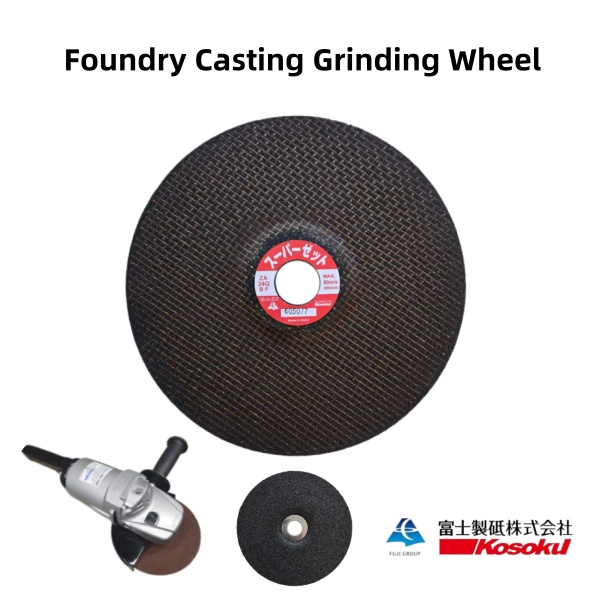
Wheel selection is part of the grinding system. For demanding casting applications, consider FUJI 180mm zirconia alumina grinding wheels for heavy-duty castings. Confirm the abrasive grade, dimensions, mounting arrangement and marked maximum speed for the actual grinder and workpiece.
Zirconia abrasive performance depends on the formulation and working conditions. The recommendation does not establish which wheel was used in the original comparison, nor guarantee the reported 2002g result. Do not deliberately overheat or overload the tool to promote self-sharpening.
No. The reported totals are 2002g for the HGC-3902, approximately 550g for the pneumatic sample and 700g for the standard AC sample. These correspond to approximately 3.64 and 2.86 times the removed mass in the reported test, not guaranteed staffing or fleet replacement ratios.
Possibly, if its voltage, phase configuration, frequency, capacity, protection and connections match the HGC-3902 requirements. Have the installation checked against the machine documentation. A suitable converter is needed where no compatible high-frequency supply is available; ordinary 50/60Hz mains must not be connected directly.
No. FUJI specifies a transient overload limit of up to 150% of rated load for no more than 3 minutes per instance for the HGC-3902 300Hz model. This is not a continuous operating target or authorization for repeated overload without recovery. Follow the model-specific instructions and thermal limits.
For the HGC-3902 300Hz model, FUJI specifies an 85K stator-winding temperature-rise limit. This is a temperature difference relative to the applicable reference temperature, not an absolute winding temperature of 85°C or a housing temperature limit.
Inspect the gears after each 300–400 hours of cumulative operation. Replace them if damaged; this is an inspection interval, not a mandatory replacement interval. Qualified service personnel should assess abnormal noise, vibration or other faults without waiting for the scheduled inspection.
Use the same casting material and defined grinding task, record the wheel specification, supply conditions, effective grinding time, mass removed, wheel consumption and finish, and repeat trials. Compare cost per acceptable completed task rather than a single headline output figure.
Send your casting material, grinding task, current tool and wheel specifications, existing HF supply details and daily operating requirements. FUJI can review compatibility and discuss a suitable on-site evaluation, product selection and quotation.
Contact FUJI / Discuss a Trial


