Grinding a marine propeller requires both effective metal removal and control of a curved working surface. Nickel-containing copper alloys, including nickel-aluminum bronze (NAB), can present difficult grinding conditions: adhering chips load the abrasive face, contact areas change across the blade, and excessive rubbing generates heat.
FUJI combines the HGC-3902 300Hz 180mm high-frequency angle grinder with custom propeller grinding wheels to address these conditions. The aim is stable grinding under load, less abrasive loading and controlled surface finishing, rather than relying on a general-purpose steel grinding disc.

Confirm the actual alloy before selecting the abrasive. A nickel-containing copper-alloy propeller and a stainless-steel propeller do not necessarily require the same wheel formulation or finishing sequence. Blade thickness, surface condition and the permitted material-removal allowance also influence the process.
The HGC-3902 provides 2600W of rated power in a 180mm high-frequency angle grinder. Compared with conventional AC angle grinders in FUJI's propeller applications, its torque and speed-holding characteristics help sustain effective grinding when the abrasive is engaged with the workpiece. Speed retention depends on the applied load and a correctly matched power supply; it is not a guarantee against speed reduction under any overload.
FUJI reports grinding efficiency approximately two to three times that of conventional AC angle grinders in its marine propeller applications. This is manufacturer-reported application performance, not a universal result for every grinder or alloy. Wheel formulation, contact pressure, workpiece condition, power supply and required finish affect the comparison. Evaluate the complete grinder-and-wheel combination against the existing process on the same task.
The HGC-3902 uses an AC asynchronous motor with a squirrel-cage rotor. It has no carbon brushes or commutator, so brush replacement is not part of motor maintenance. This does not make the whole tool maintenance-free: bearings, gears, lubrication, cables and protective components still require inspection and service according to the equipment instructions.
300Hz describes the electrical supply frequency; RPM describes rotational speed; m/s describes peripheral wheel speed. The 80m/s specification discussed for the application is a maximum operating peripheral speed, not a constant working speed or an RPM value. Actual peripheral speed depends on both rotational speed and the wheel's current diameter.
Use only a wheel approved for the tool and task, with a marked maximum RPM at least equal to the grinder's specified maximum speed. Confirm diameter, bore, mounting flanges and guard compatibility. Match the 300Hz grinder to its specified voltage, frequency, current capacity, connectors and approved power supply; do not connect it directly to ordinary 50/60Hz mains.
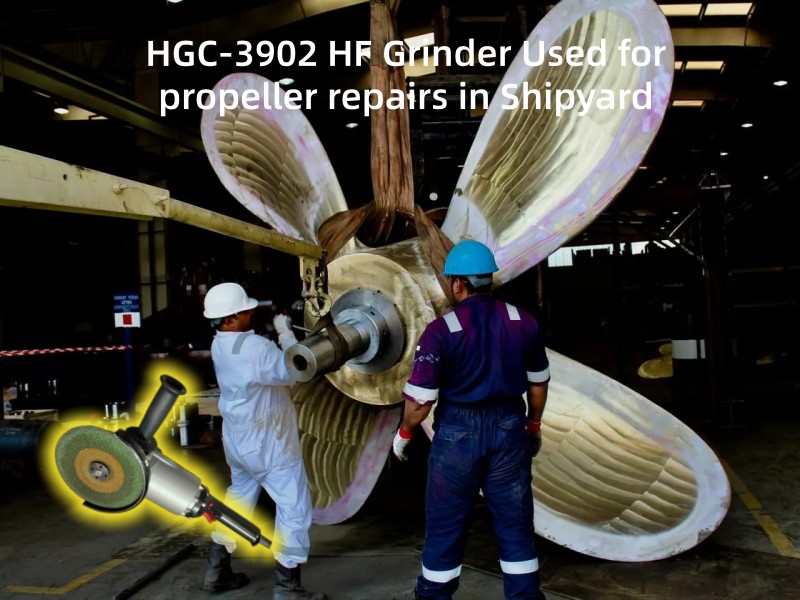
For nickel-containing copper-alloy propellers, FUJI recommends a purpose-developed grinding wheel formulated with selected abrasives including silicon carbide and zirconia alumina. The abrasive blend is selected for the material and grinding stage to support effective cutting, heat management and resistance to loading.
Conventional aluminum oxide grinding wheels intended for ordinary steel may become loaded with adhering copper-alloy debris in this application. As the abrasive face becomes covered, rubbing and heat can increase while removal efficiency falls. This is a wheel-selection issue, not a claim that every aluminum oxide formulation is unsuitable for every copper alloy.
The dedicated FUJI formulation is designed to reduce these problems and help protect the workpiece from excessive grinding heat. It does not remove the need for controlled pressure, suitable contact angles and regular inspection of the abrasive face. Stop and check the process if the wheel begins rubbing, loading heavily or producing an unacceptable surface.
FUJI also offers Green Star semi-flexible grinding wheels. The image below illustrates that product family; the custom propeller wheel formulation, dimensions and operating limits must be confirmed separately for the application.

Identify the alloy, the area to be treated and the approved repair or manufacturing requirements. Check whether the task is casting-flash removal, local surface preparation, weld blending or finishing. Cavitation pits, cracks and impact damage require assessment before material removal; grinding alone is not a substitute for an approved structural repair.
Confirm the HGC-3902 power-supply requirements and select a copper-alloy-compatible grinding wheel. Check the wheel label, condition, mounting and guard before use. Match the wheel dimensions and maximum operating speed to the machine instructions.
Work in controlled passes and keep the abrasive moving over the intended area. Use appropriate pressure rather than excessive force. Watch for wheel loading, changing cutting behavior and unwanted heat. Large gates and risers may require a separate approved cutting process or a different tool; a grinding wheel must not be assumed suitable for every cutting operation.
Progress to a suitable finishing abrasive when heavy stock removal is complete. Check the surface and blade contour against the applicable acceptance requirements. Propeller geometry, thickness and balance must remain within the specified limits; a smooth-looking surface alone does not establish an acceptable repair.

For a useful comparison, test the HGC-3902 and its matched propeller wheel against the existing equipment on comparable material and work areas. Record the abrasive specification, power supply, operating conditions and required finish.
This page presents FUJI's application approach and reported performance. It does not present a fully documented, customer-specific controlled trial. A trial on the customer's actual propeller alloy and task is the appropriate way to establish achievable results.
FUJI's abrasive manufacturing experience dates to 1953. Its grinding-wheel and power-tool ranges support matched equipment selection for industrial metalworking. For this application, the useful starting point is the propeller material and working task, followed by abrasive formulation, grinder capacity and available electrical supply.
Explore the FUJI high-frequency equipment range and grinding and finishing abrasives, or visit fujigrindingwheel.com for related products. Trial arrangements and technical support availability are confirmed for each location and project.
FUJI recommends an application-specific wheel with selected abrasives including silicon carbide and zirconia alumina. Confirm the actual alloy, grinding stage, dimensions and speed rating before ordering; a general-purpose steel wheel is not automatically a suitable substitute.
No. Peripheral speed depends on RPM and wheel diameter. The 80m/s value is a maximum operating peripheral-speed specification, not a constant operating target. Follow the machine instructions and the limits marked on the selected wheel.
No. FUJI reports this level of performance in its propeller applications compared with conventional AC angle grinders. Actual results depend on the complete process and should be verified on comparable work with the required surface quality.
Only if the supply meets the exact model's frequency, voltage, capacity and connection requirements. Share the tool and supply nameplate details with FUJI before confirming compatibility.
It does not require carbon-brush replacement. The complete grinder still needs inspection and maintenance, including its mechanical components and electrical connections, according to the manufacturer instructions.
Provide the alloy, propeller size, working-area photos, grinding or repair task, current equipment and abrasives, available power supply, and required surface finish. FUJI can then discuss a suitable tool-and-wheel combination and feasible trial arrangements.
Send FUJI your propeller alloy, work-area photos, removal task and power-supply details. Request a matched HGC-3902 and custom grinding-wheel recommendation for your manufacturing or repair process.
Request a Propeller Grinding Trial


