By the FUJI Industrial Grinding Engineering Team
Leveraging 70+ years of manufacturing expertise to help professionals optimize safety and productivity in heavy metalworking.
Using the wrong grinding wheel doesn't just waste time—it ruins expensive workpieces, burns out your power tools, and creates severe safety hazards on the shop floor. Whether you are leveling heavy welds, shaping metal, or preparing surfaces for coating, selecting the correct abrasive grinding wheel is the most critical decision an operator can make.
TL;DR: The Golden Rules of Selection
- Hard vs. Soft: Use wheels with a soft bond for hard materials (like stainless steel), and a hard bond for soft materials (like mild steel).
- Grit Size: Coarse (24-36) for fast removal; Fine (80+) for smooth finishing.
- Safety First: Never exceed the maximum RPM marked on the wheel. Verify tool compatibility before mounting.
1. The Core Triangle: Material, Grit, and Bond
Selecting a grinding wheel requires balancing three technical specifications to match your exact application. Here is our engineering breakdown:
- Workpiece Material Compatibility: This dictates everything. Abrasive grains must be harder than the material being ground.
- Grit Size Strategy:
- Coarse (24-30): Aggressive cutting. Ideal for hogging off weld seams and heavy stock removal in foundries.
- Medium (36-60): The versatile "sweet spot" for general edge blending and deburring.
- Fine (80-120): Best for refining surfaces before polishing or applying industrial coatings.
- Bond Hardness: The resin bond holds the abrasive grains together. If the bond is too hard for the application, dull grains won't shed, leading to glazing and heat damage. If it's too soft, the wheel will disintegrate too quickly, inflating your operational costs.
2. Abrasive Grain Selection Matrix
Not all abrasive grains behave the same under pressure. Use our proprietary selection matrix to choose the right chemistry for your job:
| Abrasive Type |
Best Material Applications |
Performance Characteristics |
| Aluminum Oxide (A) |
Carbon Steel, Alloy Steel, Wrought Iron |
Tough, durable grain. The industry standard choice for high-tensile ferrous metals. Excellent cost-to-performance ratio. |
| Zirconia Alumina (Z) |
Stainless Steel (INOX), High-Tensile Alloys |
Self-sharpening micro-crystalline structure. Cool cutting and ideal for heavy-duty, high-pressure applications. |
| Silicon Carbide (C) |
Cast Iron, Aluminum, Brass, Stone |
Extremely hard and sharp, but brittle. Fractures easily to maintain a sharp edge on non-ferrous and non-metallic materials. |
Pro Tip: The INOX (Stainless Steel) Rule
When grinding Stainless Steel, always ensure your wheel is marked as "Iron-Free" (Fe + S + Cl < 0.1%), typically utilizing White Alumina (WA) or Zirconia (Z). Using a standard steel grinding wheel will embed iron particles into your workpiece, causing the stainless steel to rust and fail inspection.
3. Matching Dimensions and Wheel Types
Beyond the abrasive chemistry, the physical profile of the wheel dictates accessibility and speed:
- Diameter: Larger wheels (e.g., 7"/180mm or 9"/230mm) provide higher peripheral speeds and are necessary for expansive flat surfaces in shipyards or structural steel fabrication. Smaller wheels (4"/100mm to 5"/125mm) offer the agility required for tight corners and intricate detail work.
- Thickness & Type:
- Type 27 (Depressed Center): Usually 1/4" (6mm) thick. The gold standard for heavy face grinding (operating at a 15° to 30° angle).
- Type 42 / Combination: Usually 1/8" (3mm) thick. Designed for light grinding and notching, often utilized in pipeline welding.
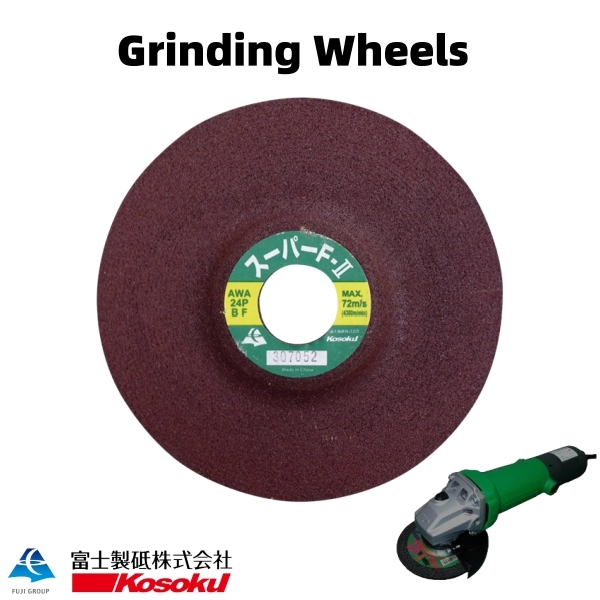
For demanding environments, Fuji's Depressed Center Grinding Wheels are engineered with premium fiberglass reinforcement to handle aggressive face grinding with maximum stability.
4. Safety Standards & Manufacturer Trust
Purchasing cheap, uncertified grinding wheels is a liability. A poorly balanced wheel not only causes rapid operator fatigue and Hand-Arm Vibration Syndrome (HAVS), but it can also shatter under high RPMs, causing catastrophic injuries.
Critical Safety Check: Match the RPM
Before mounting any wheel, check the maximum RPM printed on the abrasive label. The max RPM of the wheel must always be HIGHER than the no-load RPM of your grinder. Never force a larger wheel onto a smaller grinder by removing the safety guard.
Relying on a heritage manufacturer like FUJI Grinding Wheel guarantees compliance with strict international safety protocols. Our engineering focuses on:
- Multi-Layer Fiberglass Reinforcement: Designed to withstand extreme lateral pressure and prevent wheel bursting.
- Dynamic Balancing: Each batch is rigorously tested to ensure smooth operation, protecting both the operator's joints and the grinder's internal bearings.
Expert Troubleshooting FAQ
Q: Why is my grinding wheel turning shiny and stopping cutting? A: This phenomenon is known as "glazing". It means the wheel's bond is too hard for the workpiece, or you aren't applying enough pressure to break down the dull grains. The solution is to switch to a wheel with a softer bond to allow the abrasive to properly self-sharpen.
Q: Can I use a 6mm grinding wheel for cutting metal? A: Absolutely not. Standard grinding wheels (Type 27) are designed strictly for face grinding. Using them for lateral cutting generates extreme friction, heat buildup, and side-load stress that can cause the wheel to shatter violently. Always use a dedicated thin cut-off wheel (Type 41 or 42) for slicing operations.
Q: How should I store my resin-bonded grinding wheels? A: Store them flat on a solid shelf in a dry, well-ventilated, and temperature-controlled environment. Extreme humidity or temperature fluctuations can degrade the resin bond over time, compromising the structural integrity of the wheel.
Ready to Elevate Your Operational Efficiency?
The success of your metalworking project depends entirely on the tools you equip your team with. Never compromise on safety or removal rates. Partner with a trusted manufacturer today.
Consult a FUJI Abrasives Expert


