For industrial procurement managers and production engineers, selecting the right abrasive grinding wheel goes far beyond unit price comparison. It requires a deep understanding of bond hardness grading, thermal dynamics during grinding, and occupational safety standards. Balancing Cost-Per-Grind (CPG) with production throughput and workpiece quality is the foundation of a profitable and sustainable supply chain for metal fabrication, shipbuilding, and foundry operations.
This technical guide breaks down the core differences between Western and Japanese abrasive hardness standards, explains the engineering logic behind semi-flexible grinding wheel design, and helps B2B buyers make data-driven decisions between traditional rigid wheels and the advanced FUJI Semi-Flexible Series with proprietary zirconia alumina technology.
Bond hardness — the strength with which the bonding agent holds abrasive grains in place — is one of the most critical specifications for grinding wheel performance. It directly determines self-sharpening ability, heat generation, wheel lifespan, and operator vibration exposure. B2B buyers often face a confusing choice between ultra-hard rigid wheels and medium-hard semi-flexible alternatives, especially when comparing products from different regional standard systems.
In European and American industrial markets, the 24S hardness grade is the dominant specification for heavy-duty rigid grinding wheels. Aligned with ANSI B7.1 and EN 12413 standards, this grade features an extremely hard resin bond paired with 24-grit coarse abrasive grains.
While 24S wheels deliver aggressive stock removal and long wear life under extremely high grinding pressure, they carry well-documented drawbacks: high vibration transfer to operators, rapid heat buildup during continuous grinding, and a high risk of glazing (blunting of the wheel surface) when used at lower pressure. Their brittle bond structure also increases the risk of chipping and flying debris under impact loads.
Japanese industrial standards, championed by FUJI Grinding Wheel and defined under JIS R6211 specifications, prioritize a 36P medium-hard grade for versatile industrial grinding. This design shifts away from "the hardest possible bond" philosophy to focus on balanced performance across real-world production conditions.
| Specification | Western 24S Rigid Wheel | Japanese 36P Semi-Flex Wheel (FUJI) |
|---|---|---|
| Bond Hardness Grade | S Grade (Extra Hard) | P Grade (Medium-Hard) |
| Standard Grit Size | #24 (Extra Coarse) | #36 (Coarse, balanced removal & finish) |
| Core Advantage | Maximum durability under extreme high pressure | Balanced performance, cool grinding, low vibration |
| Heat Generation | High; high risk of workpiece burn | Low; active heat dissipation via air channels |
| Vibration Level | High; elevated HAVS risk | 40% lower; reduced operator fatigue |
The FUJI ACE Series represents the flagship application of Japanese 36P semi-flex technology. Engineered specifically for the 4-inch (100mm) angle grinder market — the most widely used size in metal fabrication and on-site construction — it directly addresses the most common pain points of traditional rigid grinding discs.
| Technical Feature | Business Benefit for B2B Procurement |
|---|---|
| Premium Abrasive Material | High-density Zirconia Alumina grains deliver 30% faster cutting speeds and 30% longer service life compared to standard brown aluminum oxide abrasives, reducing consumable replacement frequency. |
| Optimized Thickness Profile | Ultra-thin 2mm – 4mm profile ensures lightweight handling and high precision for blending and contour work, while maintaining structural integrity for stock removal tasks. |
| Shatter-Resistant Safety Design | The flexible reinforced bond prevents the catastrophic shattering common with brittle hard wheels. It drastically reduces flying debris risk from abrasive chipping, meeting ISO 9001 and JIS safety standards with a >2.0x burst safety factor. |
| Vibration-Dampening Ergonomics | Built-in elasticity absorbs grinding shock, reducing hand-arm vibration by up to 40%. This lowers the risk of Hand-Arm Vibration Syndrome (HAVS) for operators and reduces fatigue during long shifts, supporting higher consistent productivity. |
| Anti-Clog Surface Pattern | Engineered slit texture evacuates grinding dust instantly, preventing material loading (clogging) when working on soft metals like aluminum and stainless steel. |
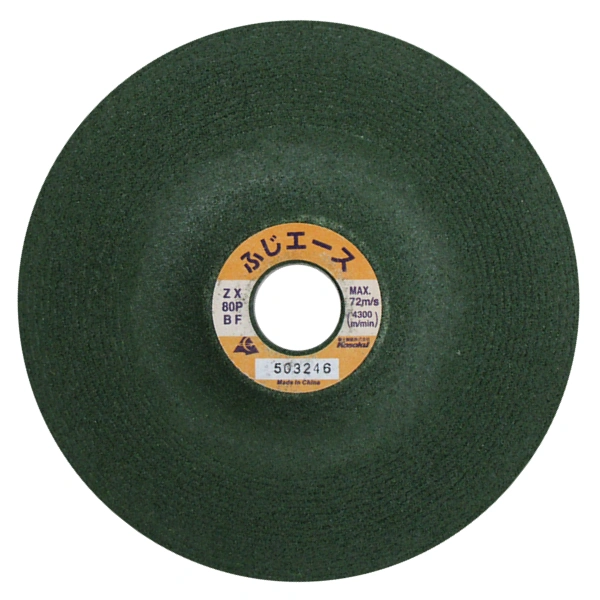
All FUJI ACE grinding wheels are manufactured under strict ISO 9001 quality management systems and comply with JIS R6211 / R6214 industrial abrasive standards. With a burst safety factor exceeding 2.0x (double the rated maximum operating speed), they exceed the safety requirements of European EN 12413 (1.73x) and American ANSI B7.1 (1.5x) standards, providing maximum protection for operators in heavy-duty industrial environments.
Thanks to its balanced 36P hardness grade and premium zirconia abrasive formulation, the FUJI ACE series functions as a multi-purpose solution across diverse industrial materials and processing tasks, eliminating the need to stock multiple specialized wheel types.
For procurement teams optimizing inventory and performance, select the appropriate hardness grade based on your specific operation:
No. The FUJI ACE features a standard depressed center (Type 27) design that mounts directly to any standard 4-inch angle grinder, just like a traditional rigid grinding wheel. It delivers semi-flexible performance without requiring additional backing accessories.
Zirconia alumina is a premium abrasive grain with higher toughness and sharper fracture characteristics. It maintains sharp cutting edges longer than standard aluminum oxide, delivers faster material removal rates, and resists wear better under high heat and pressure, resulting in 25–30% longer wheel life.
For most handheld grinding operations, 36P semi-flex wheels deliver comparable stock removal rates while offering better surface finish and lower heat. For extreme heavy-duty automated grinding with constant very high pressure, 24S rigid wheels may still offer longer wear life. For all general metal fabrication tasks, 36P wheels provide better overall versatility and value.
FUJI ACE 100mm (4-inch) semi-flex wheels have a maximum peripheral speed rating of 72 m/s (4,300 m/min), compatible with all standard high-speed angle grinders within this speed range. Always verify grinder RPM compatibility before use.
Selecting the right grinding wheel is a balance of material science, operational economics, and occupational safety. While Western 24S ultra-hard wheels have their place in specialized high-pressure heavy grinding, the Japanese 36P medium-hard standard offered by FUJI provides a smarter, more versatile solution for modern metal manufacturing — combining superior heat dissipation, industry-leading operator safety, and premium zirconia alumina performance.
With over 70 years of Japanese abrasive engineering heritage, FUJI Grinding Wheel designs and manufactures high-performance abrasives trusted by foundries, shipyards, and automotive fabrication facilities worldwide. Our semi-flex wheel technology delivers measurable improvements in both production efficiency and workplace safety.
Ready to test the "Breathing Wheel" performance difference for your operation? Contact our global engineering team to request free samples or discuss custom OEM specifications for your regional market.


